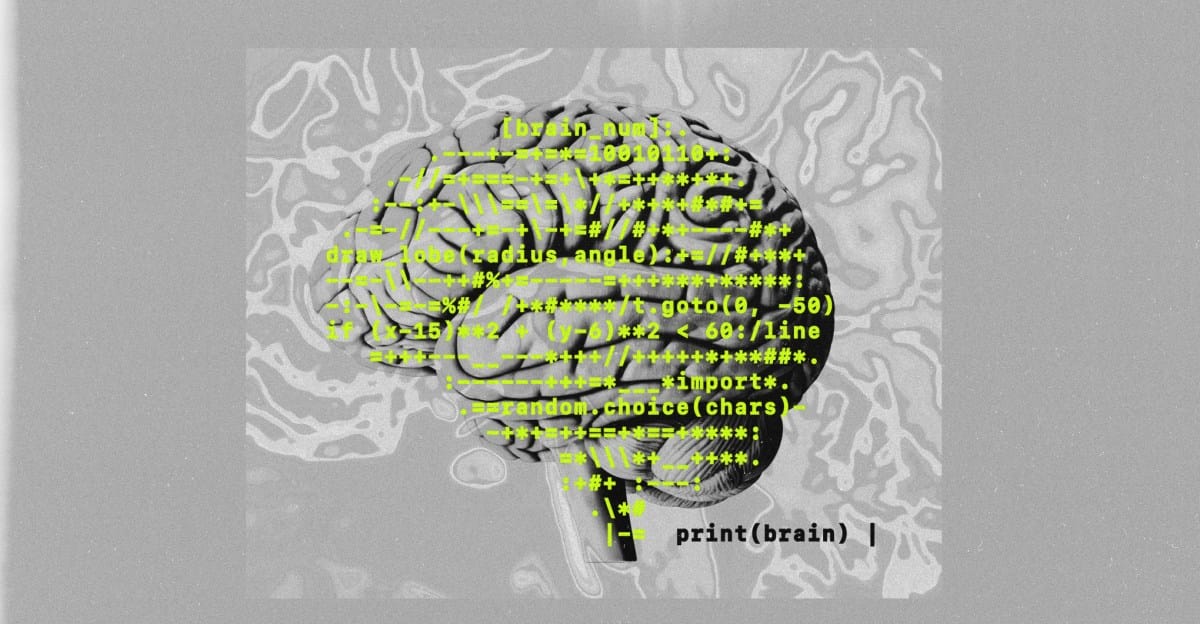
Today on Decoder, I want to lay out an idea that’s been banging around my head for weeks now as we’ve been reporting on AI and having conversations here on this show. I’ve been calling it software brain, and it’s a particular way of seeing the world that fits everything into algorithms, databases and loops — software.
Software brain is powerful stuff. It’s a way of thinking that basically created our modern world. Marc Andreessen, the literal embodiment of software brain, called it in 2011 when he wrote the piece “Why software is eating the world” as an op-ed in The Wall Street Journal. But software thinking has been turbocharged by AI in a way that I think helps explain the enormous gap between how excited the tech industry is about the technology and how regular people are growing to dislike it more and more over time.
In fact, the polling on this is so strong, I think it’s fair to say that a lot of people hate AI. And Gen Z in particular seems to hate AI more and more as they encounter it. There’s that NBC News poll showing AI with worse favorability than ICE and only a little bit above the war in Iran and the Democrats generally. That’s with nearly two thirds of respondents saying they used ChatGPT or Copilot in the last month. Quinnipiac just found that over half of Americans think AI will do more harm than good, while more than 80 percent of people were either very concerned or somewhat concerned about the technology. Only 35 percent of people were excited about it.
Poll after poll shows that Gen Z uses AI the most and has the most negative feelings about it. A recent Gallup poll found that only 18 percent of Gen Z was hopeful about AI, down from an already-bad 27 percent last year. At the same time, anger is growing: 31 percent of those Gen Z respondents said they feel angry about AI, up from 22 percent last year.
Now, I obviously talk to a lot of tech executives and policy people here on Decoder, and I will tell you, they all know AI isn’t popular, and they can all see how that’s playing out in real life. Here’s Microsoft CEO Satya Nadella talking about how the tech industry needs to make the case for the investments it’s making in AI:
Satya Nadella: At the end of the day, I think this industry, to which I belong, needs to earn the social permission to consume energy because we’re doing good in the world.
I think it’s safe to say that the tech industry and AI have not earned any of that social permission yet. Politicians from both sides of the aisle are opposing data center buildouts. Politicians in local communities that support data centers are getting voted out of office. And in the most depressing reminder of how much political violence has become a part of everyday American life, politicians who’ve supported data centers have had their houses shot at. OpenAI CEO Sam Altman has had Molotov cocktails thrown at his house.
It’s sad that I’m going to have to say this again on the show, and it’s sad that we’re going to have commenters who disagree, but this violence is unacceptable. If you want to meaningfully oppose AI in a way that lasts, you should speak loudly with your dollars in the market and your attention online, and you should speak loudly with your votes. You should participate in a democratic regulatory and political process. Anything else will get dismissed and perpetuate the cycle. That dismissal is already happening.
I also think it’s incredibly important for our politicians and tech executives to make sure our political process makes people feel empowered, not helpless, which is a specific kind of nihilism they have all greatly contributed to. The violence is a result of that helplessness and nihilism. And the most powerful people in our society ought to reckon with that, especially as they run around saying AI will wipe out all the jobs. I’m not even exaggerating this. Here’s Anthropic CEO Dario Amodei saying he thinks AI will wipe out all the jobs:
Dario Amodei: Entry-level jobs in areas like finance, consulting, tech and many other areas like that —- entry-level white-collar work — I worry that those things are going to be first augmented, but before long replaced by AI systems. We may indeed —- it’s hard to predict the future — but we may indeed have a serious employment crisis on our hands as the pipeline for this early-stage, white-collar work starts to contract and dry up.
What I see when I encounter clips like this is the true gap between the tech industry and regular people when it comes to AI — and also the limit of software brain. Like I said, everyone in tech understands how much regular people dislike AI. What I think they’re missing is why. They think this is a marketing problem. OpenAI just spent $200 million on the TBPN podcast because the company thinks it will help make people like AI more. Sam Altman has said so explicitly:
Sam Altman: Oh, they are genius marketers and I would love to have better marketing. Somebody said to me recently that if AI were a political candidate, it would be the least popular political candidate in history. And given the amazing things AI can do, I think there’s got to be better marketing for AI.
It feels like someone just needs to say this clearly, so I’m just going to do it. AI doesn’t have a marketing problem. People experience these tools every single day. ChatGPT has 900 million weekly users, trending to a billion, and everyone has seen AI Overviews in Google Search and massive amounts of slop on their feeds. You can’t advertise people out of reacting to their own experiences. This is a fundamental disconnect between how tech people with software brains see the world and how regular people are living their lives.

Image: The Verge
So what is software brain? The simplest definition I’ve come up with is that it’s when you see the whole world as a series of databases that can be controlled with structured language and software code. Like I said, this is a powerful way of seeing things. So much of our lives run through databases, and a bunch of important companies have been built around maintaining those databases and providing access to them.
Zillow is a database of houses. Uber is a database of cars and riders. YouTube is a database of videos. The Verge’s website is a database of stories. You can go on and on and on. Once you start seeing the world as a bunch of databases, it’s a small jump to feeling like you can control everything if you can just control the data.
But that doesn’t always work. Here’s an example: Elon Musk and DOGE showed up in the government, and the first thing they did was take control of a bunch of databases. And they ran into the undeniable fact that the databases aren’t reality, and DOGE ended in hilarious failure. It turns out software brain has a limit, and the government isn’t software. People aren’t computers, and they don’t live in automatable loops that can be neatly captured in databases.
Anyone who’s actually ever run a database knows this. At some point, the database stops matching reality. And at that point, we usually end up tweaking the database, not the world. The AI industry has fully lost sight of this. AI thrives on data. It’s just software. And so the ask is for more and more of us to conform our lives to the database, not the other way around.
Let me offer you another example that I think about all the time, especially as AI finds real fit as a business tool. It’s the idea that AI is coming for lawyers and the legal system. The AI industry loves to talk about not needing lawyers anymore, which is already getting all kinds of people into all kinds of trouble. But I get it. I’ve spent a lot of time with lawyers. I used to be a lawyer. My wife is still a lawyer. Some of my best friends are lawyers.

Verge subscribers, don’t forget you get exclusive access to ad-free Decoder wherever you get your podcasts. Head here. Not a subscriber? You can sign up here.
I also spend all of my time at work talking to tech people. And so over time, I’ve learned that the overlap between software brain and lawyer brain is very, very deep. Alluringly deep. If the heart of software brain is the idea that thinking in the structured language of code can make things happen in the real world, well, the heart of lawyer brain is that thinking in the structured legal language of statutes and citations can also make things happen. Hell, it can give you power over society.
There are other commonalities. Both software development and the law depend heavily on precedent. We have a body of case law in this country, and we use it over and over again to help us resolve disputes. Much like software engineers have libraries of code that they turn to repeatedly to build the foundations of their products. I can go on.
At the end of the day, both lawyers and engineers do their best to use formal, structured language to guide the behavior of complicated systems in predictable and potentially profitable ways. I am far from the first person with this idea. Larry Lessig wrote a book called Code and Other Laws of Cyberspace in 2000. It’s just as relevant today as it was a quarter century ago.
And so you have this intoxicating similarity between law and code, and it trips people up all the time. People are constantly trying to issue commands to society at large like it’s a computer that will obey instructions. There are examples of this big and small. My favorite are those Facebook forwards insisting Mark Zuckerberg does not have the right to publish people’s photos. Honestly, I look at these, and I think it would be great if the law was actually code. Maybe things would be more predictable. Maybe we’d feel more in control.
But law isn’t actually code, and society and courts aren’t computers. I have to remind our fairly technical audience on Decoder and at The Verge all the time that the law is not deterministic. You simply cannot take the facts of a case, the law as written, and predict the outcome of that case with any real certainty, even though the formality of the legal system makes people think it works like a computer, that it’s predictable.
Because at the end of the day, it’s actually ambiguity that’s at the very heart of our legal system. It’s ambiguity that makes lawyers lawyers. Honestly, it’s ambiguity that makes people hate lawyers because it’s always possible to argue the other side, and it’s always possible to find the gray area in the law. That’s why prosecutors end up working as defense attorneys and why our regulators tend to end up working for big corporations.

So you can see the obvious collision between software brain and lawyer brain. This thing that looks like a computer isn’t actually anything at all like a computer. A lot of people even argue that the law should be more like a computer, that the system should be verifiable and consistent, and that merely issuing the right commands at the right times should lead to objectively correct outcomes.
Bridget McCormack, who used to be the chief justice of the Michigan Supreme Court, was on Decoder a few months ago pitching a fully automated AI arbitration system. Her argument to me was that people perceive the traditional legal system to be so unfair, they will accept a worse outcome from an automated system as more fair as long as they feel heard. And if there’s one thing AI can do, it’s sit there and listen all day and night. I don’t know if any of that is correct or even workable, but I do know software brain, and that is pure software brain. The idea that we can force the real world to act like a computer and then have AI issue that computer instructions.
You can see the same thing happening in every other kind of industry. You don’t hire a big consulting firm to actually come in and study your business and make it more efficient. You hire them to make slide decks that justify layoffs to your board and shareholders. Big consulting firms are great at this, and now they’re just going to generate those decks with AI. They are already doing this and the layoffs have already begun.
Any business process that looks like code talking to a database in a repetitive way is up for grabs. That’s why Anthropic has been so relentlessly focused on enterprise customers, and it’s why OpenAI is now pivoting to business use. There’s real value in introducing AI to business because so much of modern business is already software, collecting data, analyzing it, and taking action on it over and over again in a loop. Businesses also control their data, and they can demand that all their databases work together. In this way, software brain has ruled the business world for a long time. And AI has made it easier than ever for more people to make more software than ever before, for every kind of business to automate big chunks of itself with software. The absolute cutting edge of advertising and marketing is automation with AI. It’s not being in creative.
But not everything is a business, not everything is a loop, and the entire human experience cannot be captured in a database. That’s the limit of software brain. That’s why people hate AI. It flattens them. Regular people don’t see the opportunity to write code as an opportunity at all. The people do not yearn for automation. I’m a full-on smart home sicko; the lights and shades and climate controls of this house are automated in dozens of ways. But huge companies like Apple, Google and Amazon have struggled for over a decade now to make regular people care about smart home automation at all. And they just don’t.
AI isn’t going to fix that. Most people are not collecting data about every single thing that they do. And if they’re collecting any at all, it’s stored across lots of different systems — your email in Gmail, your messages in iMessage, your work schedule in Outlook, your workouts in Peloton. Those systems don’t talk to each other and maybe they never will, because there’s no reason for them to. And asking people to connect them all freaks them out.
Even taking the time to consider how much of your life is captured in databases makes people unhappy. No one wants to be surveilled constantly, and especially not in a way that makes tech companies even more powerful. But getting everything in a database so software can see it is a preoccupation of the AI industry. It’s why all the meeting systems have AI note takers in them now. It’s why Canva, which is design software, now connects to corporate email systems. My friend Ezra Klein just went to Silicon Valley, and he described the people that are actively trying to flatten themselves into a database:
Ezra Klein: You might think that A.I. types in Silicon Valley, flush with cash, are on top of the world right now. I found them notably insecure. They think the A.I. age has arrived and its winners and losers will be determined, in part, by speed of adoption. The argument is simple enough: The advantages of working atop an army of A.I. assistants and coders will compound over time, and to begin that process now is to launch yourself far ahead of your competition later. And so they are racing one another to fully integrate A.I. into their lives and into their companies. But that doesn’t just mean using A.I. It means making themselves legible to the A.I.
You can give it access to everything that’s there: your files, your email, your calendar, your messages. It operates continuously in the background, building a persistent memory of your preferences and patterns so it can better act on your behalf. The cybersecurity risks are glaring, but there’s a reason millions of people are using it: The more of your life you open to A.I., the more valuable the A.I. becomes.
I’ve reviewed a lot of tech products over the past decade and a half, and all I can tell you is that it is a failure when you ask people to adapt to computers. Computers should adapt to people. And asking people to make themselves more legible to software, to turn themselves into a database, is a doomed idea. It’s an ask so big, I can’t imagine a reward that would make it worth it for anyone, even if the tech industry wasn’t constantly talking about how AI will eliminate all the jobs, require a wholesale rethinking of the social contract and — oops — also the latest models might cause catastrophic cybersecurity problems that might lead to the end of the world.
Does this sound like a good deal to you? Can you market your way out of this? This only makes sense if you have software brain, if your operative framework is to flatten everything into databases that you can control with structured language. The people paying thousands of dollars a month to set up swarms of OpenClaw agents and write thousands of lines of code, they’re people who look at the world and see opportunities for automation, to repeat tasks, to collect data, to build software. AI is great for them. It’s even exciting in ways that I think are important and will probably change our relationship to computers forever.
For everyone else, AI is just a demanding slop monster. It’s a threat. I’m not saying regular people don’t use Excel or Airtable to plan their weddings or have fun throwing PowerPoint parties, or even that AI won’t be useful to regular people over time. I think a lot of people enjoy data and tracking different parts of their lives. There’s my WHOOP band. I’m just saying these things aren’t everything. Not everything about our lives can be measured and automated and optimized. It shouldn’t be.
And so the tech industry is rushing forward to put AI everywhere at enormous cost — energy, emissions, manufacturing capacity, the ability to buy RAM — and locked into the narrow framework of software brain without realizing they are also asking people to be fundamentally less human. They then sit around wondering why everyone hates them. I don’t think a couple haircuts are going to fix it.
Questions or comments about this episode? Hit us up at decoder@theverge.com. We really do read every email!
Decoder with Nilay Patel
A podcast from The Verge about big ideas and other problems.