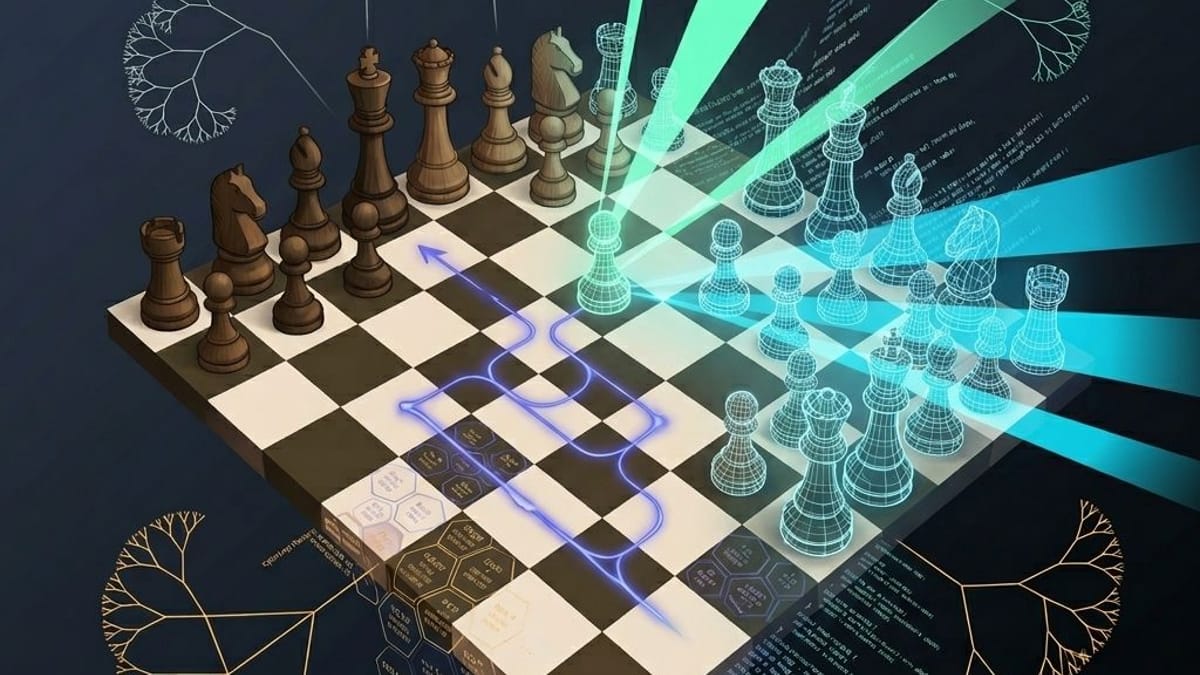
Sam Altman of OpenAI and Dario Amodei of Anthropic are playing a 4-D chess game in the mad rush to their respective IPOs. Every week, it seems like they keep raising the stakes. One day, it is about creating greater physical intelligence through robots (OpenAI) and the next week, it is about Anthropic launching an enterprise-level company entirely run by agents. Will these promises play out? Who knows?
What this inspires me to do is look at the real world of chess. Many of the doomsday scenarios we talk about today have already been part of the game of professional chess for many years. As such, this allows us to see how AI could evolve into business, government and society.
As an ancient game, Chess has captivated generations who have found it to be a blend of pattern recognition, calculation and imagination. Understanding how AI has changed one of the peak human experiences allows us to imagine where we are headed.
Spoiler- generally speaking, my view is that AI has been integrated into the world of chess beautifully through support for player training, imaginative new formats and so much more.
There is a long history of how “man vs. machine” conversations at a societal level have commenced with chess. Many readers will remember the classic fight between Gary Kasparov and Deep Blue. This was widely seen as the first crossing of a basic frontier- a machine (designed by IBM) outperforming not a pedestrian club-level chess player, but the best in the world.
Artificial intelligence has since made some impressive strides in the world of chess. One of the notable advancements was Google’s Alpha Zero. Up to this point, artificial intelligence engines worked off a database and probabilistic assessment. IBM’s Deep Blue, for instance, was built on a database of previous games- a finite solution for a finite problem space. At any point, the engine could simply recognize a pattern and arrive at a conclusion. However, this was limited by the set of games in the database.
In direct contrast, Alpha Zero was simply provided with information about the rules of chess. It then proceeded to learn and having learned, is now in a position to beat every super Grandmaster in the world. This is a staggering accomplishment. In addition to chess, Alpha Zero mastered the game, Go. So complete was its domination in the world of Go that the human champion simply decided to retire rather than continue to lose.
The world of chess engines did not stop with AlphaZero. Consider these facts:
-
Every serious chess player uses an engine to train to get better. However, they continue to work with human coaches as well. For the world championship, for instance, a player might have a whole team of human chess players who provide different aspects of expertise- opening theory, style of play etc.
-
The top chess engines outrank the best human chess player by nearly 800 elo points. This is the existential worry that a lot of people have- that AI will become measurably better than the best human players. We already have this in spades in chess- the best chess engines are meant to routinely expected to beat grandmasters. That is not a topic.
-
It is a fait accompli that engines can help human players get better and that humans will never outperform engines. This should not be viewed as the world did with Deep Blue that somehow the machines have won. Instead, it is about recognizing that this is a separate artificial intelligence entirely available to us.
-
Today, there is a separate competition for chess engines. Each chess engine has its own algorithm and the competition pits them against each other. Stockfish has been a consistent winner with others with fancy names like Komodo and Leela hold their own.
Engines, Bots and Everything Else in Between
A chess player has multiple ways to get better. S/he can work with an individual human coach, attend classes, watch other’s games, participate in competitions, read chess books etc. The list is long, but finite.

One of the simplest forms of learning has to do with analyzing one’s game(s). One could review a single game or systematically access the entire database of played games. The review can be done by an algorithm (game review) or by a human being. Some hybrid of the two can be done, of course.
The best example of this is Chess.com’s Puzzle Rush. Puzzle Rush is an autonomous learning system where an individual interacts with an algorithm to become better at chess. The participant is first provided a simple puzzle. Based on the performance on the simple puzzle, more difficult puzzles are provided. The player can play in multiple formats (3 minutes, 5 minutes, survivor and battle). The game ends when the player makes three mistakes- “three strikes and you are out.” After each game, the player can go back to mistakes and learn from them and also develop a personalized learning plan to get better.
There are now a plethora of chess bots. Each bot is based on a human player and draws from the database of games of that player. One could challenge oneself against a particular chess bot at any time. An average player can pit himself/herself against different styles of play to get better.
How the Game Changed
My favorite American chess player, Hikaru Nakamura has said- “We have brains, we should probably use them,” advising players not to sacrifice long-term cognitive skills for short-term efficiency gains. Hikaru Nakamura has repeatedly discussed how opening preparation, novelty discovery, and position evaluation are now deeply engine-driven. Mainly, 1) engines discover tactical resources humans miss, 2) AI reshapes opening theory at extraordinary speed and 3) elite players now prepare by interrogating engines rather than relying solely on classical chess texts.
This has transformed chess from purely human strategic combat into a hybrid intelligence environment.
One of the recurring themes around modern chess is that engines often produce moves humans initially regard as absurd:
-
quiet positional sacrifices,
-
long-term compensation ideas,
-
anti-classical maneuvers,
-
highly dynamic king walks.
Humans then absorb these ideas and expand their own conception of the game.
This is crucial: AI did not eliminate creativity. It changed the frontier of creativity. In chess commentaries, it is quite common to make observations such as “that’s an engine move”, “she is playing like an engine” or “there’s no way that sacrifice could come from a human”. The chess world has expanded to include the role of engines.
The way one prepares for games has also changed. A game theory analysis would suggest that one could expect one’s opponent to have trained on chess engines. Then, one could assume that the human rival will find some positions to be neutral or equal, based on engine recommendations. This will lead to understudying those positions. Pushing the opponent into these situations will result in advantage.
The most significant change to the world of chess has been the growth of freestyle (this is also called Chess 960 since there are 960 possible patterns for back row pieces). In this format, rather than the standard positions pieces occupy, both players are provided a random starting configuration. This format has proven to be energizing for the highest level of grandmasters since it underemphasizes prior calculation and creates more opportunities for stunning human intuition. Since all top chess masters play in this format, it is likely to be quite influential as the next frontier of chess games.

Chess in the world of Neuralink
It is interesting to imagine how this will evolve in the world of human-computer interfaces being produced by Neuralink, Elon Musk’s futuristic innovation that involves inserting a chip into a human being. Already, the Neuralink team has demonstrated that it can be used by a quadriplegic to play chess simply through using thoughts rather than physical movements.
This is forcing a new question into the mainstream of business and society: What happens when artificial intelligence is no longer something we merely use, but something we think alongside? For decades, human-computer interaction has been constrained by keyboards, touchscreens and voice commands. Brain-computer interfaces promise to compress that gap. Instead of typing prompts into ChatGPT or asking an AI assistant for help, humans could eventually interact with machines through intention, context and cognition itself.
At this point, we cannot say for sure if Neuralink will actually boost human intelligence to the point that it would enhance capacity to play chess at a higher level. However, it is intriguing to imagine chess in a world of cyborgs and human-computer hybrids.
Takeaways for Technology Leaders
The deeper lesson for technology CEOs is not that AI will “replace humans.” Gukesh Dommaraju remains the world chess champion and Magnus Carlsen is demonstrably the best chess player in the world. That framing is already outdated and is honestly, not useful. The chess world moved beyond that debate years ago. The real transformation came when the ecosystem reorganized itself around machine superiority. That is precisely what is now happening in business, and leaders like Sam Altman and Dario Amodei understand this intuitively. They are not merely building products. They are attempting to redefine the architecture of human work itself.
The first leadership lesson is that technological superiority changes the role of leadership rather than eliminating it. In chess, the existence of engines stronger than humans did not destroy chess. Instead, it changed what it meant to be a strong chess player. Today’s grandmasters are not simply calculators. They are curators, interpreters, strategists, and synthesizers of machine-generated insight. The same evolution is coming to the executive suite. CEOs will increasingly lead organizations where AI systems outperform humans in forecasting, analysis, coding, optimization, and even tactical decision-making. The value of the executive will therefore migrate upward—from operational intelligence toward contextual intelligence. Leaders who merely process information will become obsolete. Leaders who frame problems, define ethics, allocate trust, create culture, and interpret ambiguity will become more valuable than ever.
The second lesson is that every major AI advance changes competitive tempo. Deep Blue defeating Kasparov was symbolic. AlphaZero was existential. Deep Blue relied on historical games and brute-force computation. AlphaZero learned independently from first principles and generated strategies no human had previously conceived. That distinction matters enormously for CEOs. The next generation of firms will not merely automate existing workflows. They will discover entirely new pathways to value creation that human organizations would never have imagined. This is why the current AI race feels unstable. When OpenAI speaks about robotics or Anthropic discusses agentic enterprises, they are signaling that the battleground is no longer software alone. The competition is about who builds the dominant cognitive infrastructure layer for the economy.
The third lesson is that human expertise does not disappear after machine dominance—it becomes amplified through collaboration. Every serious chess player now trains with engines. Refusing to use one would be irrational. Yet human coaches remain indispensable because development still requires emotional calibration, motivation, interpretation, creativity, and identity formation. The same hybrid model will emerge across industries. The best lawyer will not be the lawyer with the best memory. The best marketer will not be the one who writes the fastest copy. The best CEO will not be the person who personally generates the most ideas. Instead, elite performers will be those who can orchestrate systems of intelligence: humans, agents, models, data streams, and autonomous workflows working in concert.
This suggests a fourth leadership lesson: future organizations will increasingly be judged by their “human-AI operating system.” Some firms will treat AI as a productivity tool. Others will redesign themselves around AI-native workflows. The difference will resemble the gap between amateur chess players occasionally consulting an engine and professional grandmasters integrating engines into every aspect of preparation. In this future, organizational advantage will emerge from recombinant AI fluency—the ability to combine multiple models, multiple agents, and multiple forms of human expertise into coherent systems. CEOs will need to think less like managers and more like conductors of distributed intelligence.
There is also a sobering governance lesson from chess. Once engines became decisively stronger than humans, the legitimacy of competition itself had to be reconsidered. Entire anti-cheating systems emerged because a single hidden engine could overpower world-class talent. Business and government are approaching a similar inflection point. When AI systems can generate persuasive arguments, write code, manipulate markets, or influence populations at superhuman scale, institutions built for slower human cognition become fragile. The challenge for CEOs will therefore not merely be innovation, but institutional resilience. How do you preserve trust, accountability, and legitimacy when machine intelligence becomes ubiquitous and asymmetrically powerful?
Finally, chess teaches us something profound about human worth. Even though engines are vastly superior players, humans still watch human chess. We still admire courage, creativity, intuition, psychological resilience, and style. Magnus Carlsen matters not because he is stronger than Stockfish, but because he is human. That distinction will become increasingly important in business and society. As AI systems become economically dominant, scarcity may shift away from computation and toward authenticity, judgment, and human connection.
The CEOs who thrive in this next era will not simply build better models. They will understand a deeper truth: once intelligence becomes abundant, humanity itself becomes the differentiator.