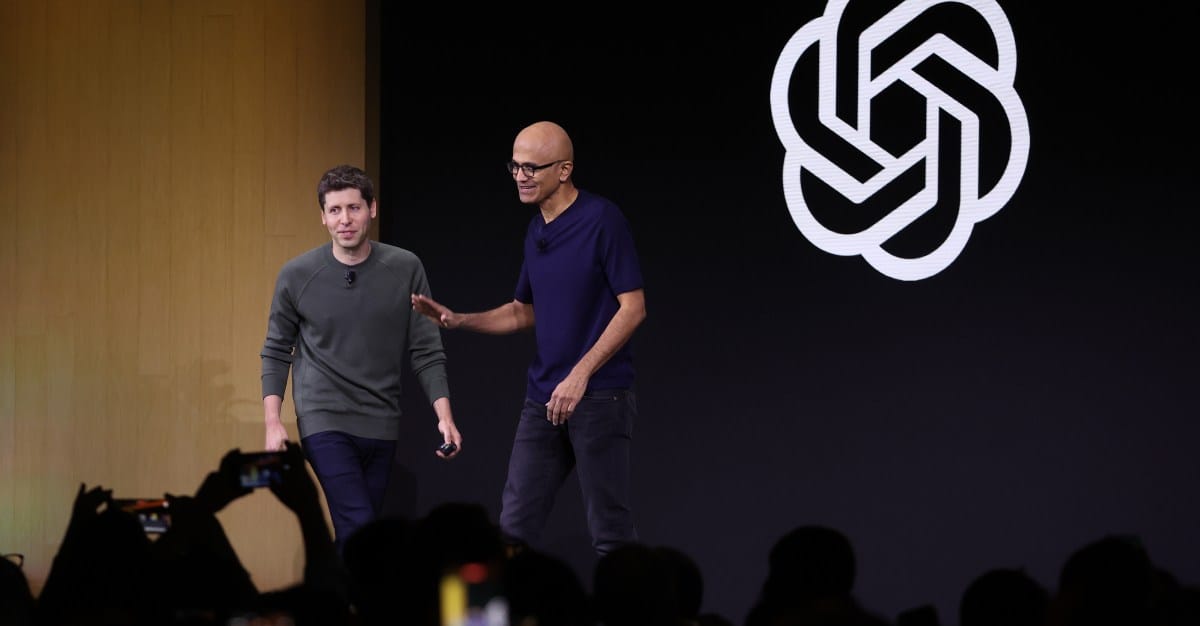
Microsoft’s relationship with OpenAI has always been complicated, so I expected the close partnership-turned-situationship to end in tears. After all, executive disagreements, rearranged contracts, and frustrations over AI infrastructure have all regularly been part of the partnership, creating plenty of tension along the way. But against all odds, Microsoft and OpenAI divorced this week in a way that looks strangely amicable.
Microsoft announced the updates to its long-standing OpenAI deal on Monday, with the most important change allowing OpenAI to make its products and services available across all cloud providers. A day later, OpenAI announced it was bringing its latest AI models, Codex, and other tools to AWS — Microsoft’s biggest cloud rival.
It’s a move that seemed likely ever since Amazon announced its $50 billion deal with OpenAI earlier this year, which was originally framed as a deal to make AWS a third-party provider of OpenAI Frontier, together with some collaborative work on custom models for Alexa. Microsoft wasn’t happy about OpenAI cutting a deal with its main rival, and it was weighing legal action ahead of this renegotiation.
Amazon and OpenAI clearly wanted a closer partnership, especially as Amazon is playing catch-up in the AI market and trying to push agents to businesses through its Bedrock service. OpenAI told its employees earlier this month that its deal with Microsoft “has also limited our ability to meet enterprises where they are — for many that’s Bedrock.” Ouch.
As much as Microsoft will hate seeing OpenAI models being available to Amazon, it now stands to benefit from OpenAI cozying up to its rival. Sources tell me that as part of the amended agreement, Microsoft will continue to receive 20 percent of the revenue OpenAI earns for ChatGPT and the AI startup’s API platform. This also includes a cut of any revenue OpenAI earns from putting its products and services on rival cloud platforms like AWS. There’s a revenue cap, but this seems mutually beneficial for both Microsoft and OpenAI even if the Amazon deal originally angered Microsoft.
Microsoft will remain “OpenAI’s primary cloud partner” and ship OpenAI’s latest products first on Azure, but the lack of exclusivity now means OpenAI’s new models can ship minutes later to rival cloud platforms. I wouldn’t be surprised to see OpenAI’s models also appear on Google’s Gemini Enterprise Agent Platform service in the future.
That gives Microsoft less of an advantage over its rivals, particularly for its Azure OpenAI service and its Foundry efforts. Microsoft’s non-exclusive license for OpenAI models and products will now last through 2032, a two-year extension over the previous 2030 cutoff date.
The revenue sharing is also one way now, so Microsoft no longer has to pay 20 percent of its Azure OpenAI revenue back to OpenAI. This new deal also means Microsoft won’t be paying a revenue share to OpenAI if its search and news advertising revenue grows by 15 percent year over year. Microsoft still owns around 27 percent of OpenAI’s for-profit arm, too, making it a major shareholder in OpenAI’s future growth.
This amicable split but not-a-split has only been made possible because Microsoft’s access to OpenAI models is no longer tied to a clause about artificial general intelligence (AGI), something that has long dictated OpenAI and Microsoft’s partnership. The removal of the AGI clause means Microsoft will no longer lose access to OpenAI’s most advanced future models once AGI is theoretically reached. And on the flip side, OpenAI is no longer incentivized to declare AGI to get out of the deal.
The pair had been arguing about the AGI clause for well over a year, and things got particularly heated when OpenAI was considering a $3 billion deal to buy AI coding tool Windsurf last year. OpenAI wanted Windsurf to be exempt from the deal with Microsoft, and even reportedly considered accusing Microsoft of anticompetitive behavior. OpenAI eventually backed down on its Windsurf acquisition plans, but sources at Microsoft tell me it led to months of tense negotiations over OpenAI’s controversial for-profit restructuring last year.
I understand Microsoft first became wary of OpenAI as a partner when Sam Altman was ousted as CEO in 2023 by the nonprofit’s board of directors. This wariness led to Microsoft CEO Satya Nadella recruiting DeepMind cofounder Mustafa Suleyman to lead its Microsoft AI business. Altman was reportedly “angered” that Suleyman had joined Microsoft, especially as Suleyman’s team started dealing directly with OpenAI engineers.
The tension between Suleyman’s teams and OpenAI came to a boiling point when Microsoft’s AI chief yelled at former OpenAI CTO Mira Murati during a meeting in 2024, reportedly demanding access to OpenAI code. While Microsoft cofounder Bill Gates, CTO Kevin Scott, and Nadella had all delicately brought the OpenAI deal to life, Suleyman was hired to shake things up and create Microsoft’s own AI models so that in the future it’s less reliant on OpenAI.
Parts of these deal changes also seem designed to distance Microsoft from the chaos of OpenAI and Sam Altman. OpenAI is increasingly juggling public controversies, strategy shifts, and a slew of executive reshufflings. It certainly feels like the vibes are off, and the contract update comes in the same week that Elon Musk and Altman are in court battling over the future of the AI company. Microsoft has already started getting dragged into this drama.
Away from the courtroom antics of Musk and Altman, Microsoft is still quietly trying to build models good enough to replace OpenAI’s. It’s had some impressive results with models like MAI-Transcribe-1, a speech-to-text model that works across 25 different languages. But most of Microsoft’s own AI models have been very task specific or smaller in size compared to OpenAI’s large language models.
To make up for this gap, Microsoft is increasingly turning its attention to options from Anthropic that are more powerful than OpenAI’s models for certain tasks. Sources at Microsoft tell me the company has even considered using Google’s Gemini models for certain products, just like how it rapidly started trialing Anthropic’s Claude Code.
Microsoft is willing to use the best AI model for the job, in an effort to keep businesses hooked to its enterprise software offerings and fend off competition from AI startups and even OpenAI itself. Some of the tension throughout Microsoft and OpenAI’s partnership has been related to the collision course the pair have both been on, each trying to convince the same mutual customers to purchase their AI services.
All this points toward Microsoft’s AI future as a mix of models developed internally and by OpenAI, Anthropic, and others. It leaves Microsoft and OpenAI with a partnership that’s a lot more about finances than close collaboration on the future of AI. They’ll still be closely linked, but the partnership-turned-situationship is looking a lot less complicated than before.
- Microsoft brings Xbox back, scraps Microsoft Gaming. Just days after announcing an Xbox Game Pass price cut, Xbox CEO Asha Sharma revealed to employees that Microsoft Gaming is now returning to just Xbox. Microsoft originally switched branding to Microsoft Gaming at the same time it announced its plan to acquire Activision Blizzard in 2022. Phil Spencer was promoted to Microsoft Gaming CEO at the time, but Sharma is now reverting those changes. “Xbox needs to be our identity,” said Sharma to Xbox employees.
- The “We Are Xbox” rallying of the troops. Alongside Microsoft Gaming returning to just Xbox, Sharma and Xbox chief content officer Matt Booty sent a joint memo to Xbox employees laying out their vision for the future of Xbox. “We Are Xbox” was the message, rallying Xbox employees to focus on the frustrations of players. Xbox will now be judged on daily active players and the priorities of hardware, content, experience, and services. Sharma has only been in the job for a couple of months, but she’s certainly starting to make her mark. There are still plenty of big questions over how her strategy will be different from the previous Xbox leadership, particularly when it comes to a renewed console focus and questions around game exclusivity.
- Xbox has a new logo. As part of Sharma’s all-hands, Microsoft started showing off a new Xbox logo on its campus this week. The logo has more of a glassy, transparent look, and I understand Microsoft has also been using this new design for some of its internal Project Helix materials. Microsoft has also plastered the “return of Xbox” slogan on the walls of its Xbox offices this week, along with “great games” and “future of play.”
- GitHub had another major outage. In last week’s Notepad issue I reported on employee concerns about GitHub reliability, and then hours later GitHub had a major outage. It was a particularly bad one, thanks to a bug that randomly reverted previously merged commits (code snapshots). Then on Monday GitHub had a search-related outage. GitHub CTO Vladimir Fedorov admitted that “both of those incidents are not acceptable,” in a blog post promising more transparency for incidents. It seems like GitHub is struggling to scale with the increased demand of AI development workflows, and it’s stressing all of its systems. I suspect the migration to Azure is also adding some complexity in the short-term, too.
- Microsoft will let you pause Windows Updates indefinitely, 35 days at a time. Windows 11 users won’t be forced to apply a Windows update in the middle of a game or during busy work. Microsoft is rolling out a lot of changes to Windows Update, including the ability to delay updates indefinitely at up to 35 days at a time. That means you’ll soon be able to pause updates for a 35-day window and keep re-pausing them at the end of that 35-day window. I think it makes sense that Microsoft won’t let people turn off Windows Update altogether, but there’s a lot more flexibility on the way to make it less annoying.
- Leak reveals new Xbox Game Pass ‘Starter Edition’ that’s part of Discord Nitro. Microsoft started teasing a mysterious Discord and Xbox Game Pass partnership last week, and a new leak has uncovered details on an Xbox Game Pass “Starter Edition” that will be bundled with Discord Nitro. The Starter Edition reportedly includes “access to over 50 games from the Game Pass library,” as well as 10 hours a month of Xbox Cloud Gaming streaming and the ability to earn Xbox Rewards points while playing games. Titles like Stardew Valley, Grounded, and Fallout 4 will be included, and we’re now waiting on Microsoft to make this new tier official.
- Microsoft Office can now be controlled with Logitech’s MX Creative Console. Logitech now has a suite of productivity plug-ins for its MX line of accessories, including its Stream Deck alternative. Shortcuts and actions for Word, Excel, and PowerPoint will all be available on the buttons of the MX Creative Console, making it easier to pin favorite Office tasks instead of having to find them in the Ribbon.
- Microsoft is giving its Xbox employees an Xbox email address. After scrapping Microsoft Gaming and promising Xbox employees that “We are Xbox,” Microsoft is now giving its Xbox employees an Xbox email address. The new Xbox email address will replace an existing @microsoft.com address as the default way to send new emails, and employees will be able to opt out and keep their Microsoft email address as the default send-from address instead. It’s a small and subtle change that’s being made as part of “strengthening the Xbox identity inside and outside of Microsoft,” according to an internal Xbox memo seen by The Verge. Activision and Bethesda employees also use their own domain for emails, but this change allows the broader Xbox team to have a similar appearance in emails to partners and developers.
- GitHub rushed to fix a critical vulnerability in less than six hours. While there are ongoing concerns about GitHub reliability, engineers at Microsoft rushed to fix a critical vulnerability last month in less than six hours. Wiz Research used AI models to uncover a vulnerability in GitHub’s internal git infrastructure that could have allowed attackers to access millions of public and private code repositories. GitHub’s engineering team developed a fix and deployed it just over an hour after identifying the root cause, protecting both GitHub.com and GitHub Enterprise Server.
- Microsoft reports sinking Xbox revenue as its cloud business climbs. Microsoft reported its Q3 2026 fiscal earnings this week, and its Xbox gaming division took a hit this time around. Xbox hardware revenue was down 33 percent, Xbox content and services revenue was down 5 percent, and overall gaming revenue was down 7 percent. Microsoft CEO Satya Nadella reflected on the recent Xbox leadership changes and renewed focus on Windows in an earnings call, saying the company is making an effort to “win back fans across Windows, Xbox, Bing, and Edge.” Sharma also took to X to admit that “player and revenue growth has not yet met our ambition,” and that “We know we have work to do to earn every player today and into the future.” Outside of consumer, Microsoft’s cloud business continues to flourish, with the company reporting $54.5 billion in revenue, marking a 29 percent year-over-year increase. Microsoft 365 Copilot saw growth as well, with paid seats jumping from 15 million in the previous quarter to 20 million.
- GitHub Copilot is moving to usage-based billing. All GitHub Copilot plans are moving to usage-based billing in June. That means every Copilot plan will include a monthly allotment of GitHub AI Credits, with the option to purchase more. “Usage will be calculated based on token consumption, including input, output, and cached tokens, using the listed API rates for each model,” says Mario Rodriguez, chief product officer at GitHub. It’s a controversial change, but it’s part of the ongoing AI money squeeze where we’re starting to see companies introduce ads, rate limits, or feature restrictions in a bid to get more people paying for AI services.
- Outlook gets a Copilot upgrade. Microsoft is upgrading its Copilot integration in Outlook to make it more agentic, so Copilot can triage emails, reschedule meetings, and more. The most interesting change is allowing Copilot to fully manage your calendar and resolve conflicts or prioritize meetings. This is something that’s typically a full-time job for many executive assistants, and Copilot will still need to be prompted to manage this side of a calendar properly.
I’m always keen to hear from readers, so please drop a comment here, or you can reach me at notepad@theverge.com if you want to discuss anything else. If you’ve heard about any of Microsoft’s secret projects, you can reach me via email at notepad@theverge.com or speak to me confidentially on the Signal messaging app, where I’m tomwarren.01. I’m also tomwarren on Telegram, if you’d prefer to chat there.
Thanks for subscribing to Notepad.