Kled is a four-month-old San Francisco data marketplace, founded by Avi Patel and backed by Sebastian Thrun (Waymo), Bernard Arnault’s Aglaé Ventures, K5 Global and a roster of crypto-aligned investors. It pays users small sums (minimum withdrawal $25, top users reportedly clearing a few hundred dollars a month) to upload photos, videos and documents that are bundled into datasets and licensed to AI labs. The company has reported roughly $300,000–$600,000 in cumulative global payouts, claims 3 million daily file uploads from around 200,000 contributors, and was valued at $100 million in December 2025.
In early May 2026, Patel announced an IP-level ban on Nigeria after concluding that 95% of Nigerian uploads were fraudulent (including more than 500 photoshopped Japanese passports submitted in a 48-hour window) while continuing to operate “every other area in Africa” and topping App Store charts in Malaysia, Indonesia and the Philippines.
The Kled story sits inside a global data-labour pattern documented by reporting on Scale AI/Remotasks (which abruptly cut Kenyan, Nigerian and Pakistani workers in 2024), Sama (Kenyan content-moderation lawsuits), and Appen’s Venezuelan workforce — all of which point to the same structural physics. African data-protection law has, in theory, advanced sharply: Nigeria’s NDPA 2023 has extraterritorial scope, the African Union’s Malabo Convention came into force in June 2023, and Kenya’s 2023–2025 takedown of Worldcoin set a precedent for invalidating “consent” obtained through micro-payments to economically precarious users. The question is whether that scaffolding will be used.
When Avi Patel announced that Kled was IP-banning Nigeria, his post took a familiar shape. There was the obligatory affection (“we’ll continue to support every other area in Africa”), the data-driven indictment (95% fraud, black screens, AI-generated junk, photoshopped Japanese passports), and the founder’s exhausted sigh (“That was the final straw. As a startup, we can’t afford to eat the costs of that data overhead”). It was clean, viral and lightly aggrieved. The corporate equivalent of a landlord telling a dinner party how impossible his tenants have become. What it was not was a serious account of what Kled is, what Kled does, and why a country of 230 million people might rationally treat its app as a thing to be looted rather than a side-hustle to be cherished.
To see Kled clearly, you have to refuse the founder’s framing.
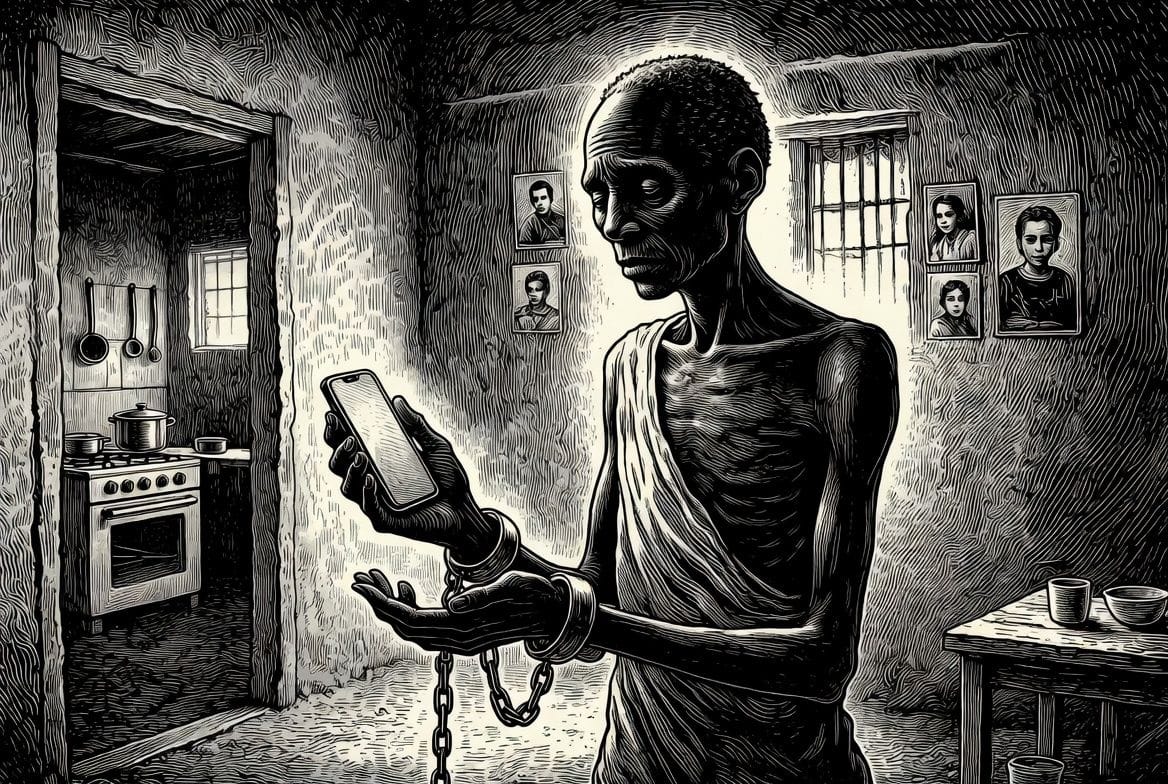
Kled is not a benevolent intermediary “letting people get paid for their data.” It is a multimodal extraction pipeline. Users are required to submit government ID for KYC, then are nudged to upload exactly the categories of content the company tells investors are most valuable: “egocentric POV datasets for robotics training, including cooking, household chores, manufacturing workflows,” “real-world behavioural clips,” “everyday household behaviours,” and integrations that hoover passive data from Google Drive, Dropbox, Spotify, Netflix and Uber. The user-facing handbook is unsubtle about this: “You are the best labeler of your own life.” The contributor’s home, kitchen, neighbourhood, body, and family rituals are the product. The currency moving in the other direction, a few cents to a few dollars per upload, with a $25 minimum cash-out, is the rounding error on a market that Mordor Intelligence and Grand View Research estimate is heading from roughly $3–5 billion in 2025 to between $17 billion and $29 billion before 2032.
Meta paid nearly $15 billion for a stake in Scale AI in mid-2025 specifically because high-quality, provenance-cleared human data has become the binding constraint on frontier models. The asymmetry is not incidental. It is the entire business plan.

This is the structural shape Nick Couldry and Ulises Mejias label data colonialism: an emerging social order in which a valuable resource (in their formulation, the texture of human life itself) is appropriated from the many for the benefit of the few, with the appropriation discursively laundered as “sharing” or “opportunity.” The historical resonance is uncomfortably exact. The British South Africa Company also told the advisors of King Lobengula that the telegraph wires being run across their land were a gift of modernity. Five centuries of resource extraction (rubber, cocoa, tin, oil) were similarly framed as voluntary trades between mutually consenting parties, with the price asymmetry presented as the natural reward of those who happened to own the refineries. Kled simply updates the metaphor: the refinery is now a model-training pipeline in San Francisco, and the cocoa is the inside of your one-bedroom in Surulere.
KYC and the Agentic AI Problem
The KYC requirement is the part of this that should make every African data-protection authority sit up. Patel’s own statement notes that Kled’s downstream buyers include “AI labs, governments, and research institutions.” The platform retains identity documents to issue payments and to satisfy its fraud-detection systems. It also retains your camera roll, your household POV footage, and increasingly the metadata streaming from your linked accounts.
Individually, each item is mundane. In aggregate, they are a profile. A 2019 study in Nature Communications showed that 99.98% of Americans in a “de-identified” dataset could be re-identified from just 15 demographic attributes; modern model-inversion attacks, documented in arXiv preprints throughout 2024 and 2025, can reverse “safe” embeddings back into recognisable faces and rooms. The European Data Protection Supervisor warned in 2025 that agentic AI multiplies these risks “in unforeseen ways,” because once an autonomous agent can join your verified ID to your kitchen video to your Spotify history to your Uber pickups, the boundary between “anonymised dataset” and “personal dossier” collapses in a single SQL join.
Kled’s own filings claim “Personally Identifiable Information is stripped” and a “Proof-of-Data” hash is written to Solana — but the company simultaneously markets datasets to enterprise buyers as carrying provenance and rights-clearance, which by definition requires linkage back to the human contributor. You cannot promise both at once.
Now layer in who Kled is asking to do this. Nigeria’s official youth unemployment rate is 6.5%, but that figure rests on a controversial 2023 methodology revision that classifies anyone working one hour a week as employed. The National Bureau of Statistics’s own pre-revision figure put youth unemployment at 53.4%. Afrobarometer’s 2025 survey found that 60% of Nigerian youth have considered emigrating, with the share thinking about it “a lot” tripling since 2017. Forty per cent of Nigerians, roughly 83 million people, live below the national poverty line; informal employment is north of 90%. Into that economy, you drop an app that promises a stranger in San Francisco will pay you in PayPal or Solana for the contents of your phone. The notion that the resulting consent is “freely given” is a fiction with the structural integrity of damp cardboard. The Kenyan High Court reached precisely this conclusion in 2024 about Worldcoin, ruling that consent obtained from people under acute financial pressure in exchange for crypto tokens was, as a matter of law, induced rather than voluntary.
Spotlight: The Fraud & The Colonial Supply Chain
Which brings us to the fraud, and to the founder’s outrage. Yes: Nigerians on Kled uploaded black screens, recycled JPEGs, AI-slop, and photoshopped Japanese passports with their own faces grafted on. Yes: this is fraud in the ordinary commercial sense. But this is not unique pathology. It is the predictable, almost mechanical response of people inside an extractive system who have correctly intuited the actual exchange rate.
If a company is valuing your kitchen at three cents and reselling it at scale to OpenAI and Anthropic for orders of magnitude more, the rational move is not to hand over your kitchen but to test what the company will accept. The colonial administrator’s diary is full of identical complaints: the locals have stolen from the company store; the labourers have falsified their tally sheets; the natives are, as ever, ungovernable. The complaint is structurally identical because the system is structurally identical. It is the offer, not the response, that is the anomaly. Patel’s “ton of friends from Nigeria” disclaimer, followed by a regional IP ban, is the same rhetorical move that “I have nothing against [colonized population], but…” has always been: a personal exemption that masks a structural verdict.
The Malaysia/Indonesia/Philippines comparison Patel offers, markets, he says, run under 10% fraud despite being larger, is meant to make Nigeria look uniquely bad. But think about it… It actually does the opposite. It reveals that Kled’s entire operational map is a tour of low-income, high-English-speaking, high-smartphone-penetration markets, the same circuit Scale AI’s Remotasks ran before Karen Hao’s reporting (in MIT Technology Review and now in her book Empire of AI) detailed how the company exploited Venezuela’s economic catastrophe to pay LIDAR annotators “pennies per task,” then “robo-fired” workers in Kenya, Nigeria and Pakistan in March 2024 when wages and complaints rose.

It is the same circuit that took Sama’s content-moderation work to Nairobi at $1.50–$2/hour while OpenAI paid Sama $12.50/hour for the same labour. It is the same circuit that put Worldcoin’s iris-scanning orbs in Nairobi shopping malls before the Kenyan ODPC shut them down. The difference between Kled and these predecessors is mostly cosmetic: Solana payouts instead of PayPal; “egocentric POV datasets” instead of bounding boxes. And that cosmetic difference makes the underlying geometry easier, not harder, to see. The platforms have become more vertical: instead of paying you to label somebody else’s data, they are now paying you to be the data.
The economic dynamics deserve a final hard look. Kled has paid out somewhere in the low six figures globally to date. It has raised roughly $9–10 million in seed capital, was valued at $100 million in December 2025, and claims to have signed “$1 billion in projected IP rights.” The token, $KLED, traded around $0.012–$0.014 in early 2026 with a circulating supply of 1 billion, and Dashcoin Research’s on-chain investigation in mid-2025 alleged that wallets linked to the team systematically sold roughly $500,000 of tokens after publicly announcing a buyback program, a controversy Patel publicly acknowledged. Whatever one makes of the crypto sub-plot, the macro point stands: the value capture is happening at the founder, investor and enterprise-buyer layer, and the value generation is happening on the floor of a flat in Lagos. That is a colonial supply chain. It is not made non-colonial by the fact that the user clicked “I agree.”
##What is to be done?
The Kled case is, paradoxically, a gift to African regulators, because the founder has helpfully published the company’s own confession in screenshot form. The NDPA 2023 has explicit extraterritorial reach: any organisation processing the data of people in Nigeria, regardless of where it is domiciled, is in scope. The Nigeria Data Protection Commission can require Kled to register as a data controller of major importance, demand a Data Protection Impact Assessment for the KYC-plus-environmental-imagery combination, mandate the deletion of all data collected from Nigerian IPs, and impose the statutory penalty (the higher of ₦10 million or 2% of annual gross revenue).
The AU Malabo Convention, in force since June 2023 across at least fifteen states, provides a regional scaffolding for the same move. Kenya has already shown that this is not theoretical: Worldcoin’s biometric data was, by court order, fully deleted, and the ODPC publicly verified the erasure in January 2026. The deeper question is whether the continent will articulate, before the next Kled launches, an affirmative position on data sovereignty. That position has to do four things at once:
- Recognise that data extracted from African environments is an African resource
- Reject “consent” extracted under economic duress as a valid lawful basis
- Mandate localisation, audit, and right-to-deletion for any cross-border training-data transfer, and
- Build the institutional muscle (the NDPC, the Network of African Data Protection Authorities, civil-society litigants like Kenya’s Katiba Institute) to actually enforce it.
Patel will almost certainly come back. He has already said as much: the suspension “may not be permanent,” and Kled “may return to work with individuals from the country when the time is right.” The right question is not whether Nigerian users will once again line up to upload their kitchens for $25. The right question is whether, by the time he returns, the legal architecture will treat that transaction as the structurally coercive thing it is. And whether the photoshopped Japanese passport will be remembered, correctly, as a small, scrappy, very Nigerian act of refusal.
_
Disclaimer: The views expressed here are solely the author’s and not those of TechBuzz._