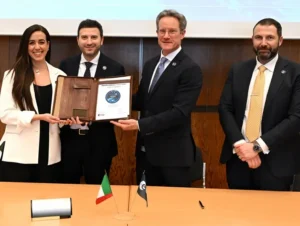
The **WEF summit in Davos** is happening right now. As expected AI dominated the headlines and trade wars got the panels.
But three announcements flew under the radar that together **signal the biggest shift in food systems in a generation**.
**And almost nobody connected the dots.**
The **Rockefeller Foundation** unveiled the **Periodic Table of Food Initiative**. The **WHO** called for massive **tax increases on sugary drinks**. And a new consulting report declared America is approaching “**peak calorie**.”
These are separate aspects of the same story. And if you understand what’s happening, you’ll see why transparent food funding matters more than ever.
## The Food Industry Just Hit a Wall
Let’s start with the numbers that food executives are panicking about.
Management consulting firm **Kearney** released a report last week showing the global food system is breaking away from traditional operating models. Their finding? The old food system playbook doesn’t work anymore.
**Here’s what they found:**
– Input costs surged 78% for fertilizer and 66% for pesticides since 2020
– 68% of consumers now buy more store brands to combat inflation
– Technology is moving from “optional to essential” across the entire food chain
Rob Dongoski, Kearney’s global food and agriculture lead, put it bluntly: companies that move fastest to automate, build regional agility, and align with consumer needs “will define what comes next.”
Translation: The industry is scrambling for a new model.
## “Peak Calorie” Is Coming
It gets worse for traditional food companies.
L.E.K. Consulting just published research showing America is approaching what they call “peak calorie”, a point where total caloric consumption stops growing.
**The culprit? A “triple whammy” of headwinds:**
1. Decelerating population growth
2. Declining immigration
3. GLP-1 weight loss drugs suppressing appetite
Their projection: US caloric consumption growth will range from negative 0.3% to positive 0.3% annually from 2025 to 2035. Essentially flat.
Here’s the kicker most people missed: population deceleration is actually the stronger headwind than GLP-1s. The demographic shift matters more than Ozempic.
L.E.K.’s base case uses Congressional Budget Office forecasts and assumes 17% GLP-1 penetration. Their modeling shows a future where net migration drops 66%, birth rates continue declining, and deaths are forecast to exceed births by 2031.
Maria Steingoltz, L.E.K. managing director, framed it this way: “Peak calorie doesn’t mean peak profit or lack of growth opportunities for companies. We’re seeing rising demand for higher-protein, higher-fiber, more satiating options.”
Rob Wilson, study co-author, added: “When market expansion slows, discipline decides the winners. The $2 trillion-plus food and beverage industry will feel the pressure.”
The food industry can no longer just sell more food. They need to sell better food.
## WHO Wants to Tax Your Soda (Again)
Also this same week, the **World Health Organization** released two global reports calling for significantly higher taxes on sugary drinks and alcohol.
The data is damning:
– At least 116 countries tax sugary drinks, but most taxes are too low to change behavior
– The median tax adds only 2% to the price of a typical soda
– Taxes have failed to keep pace with inflation, making sugary drinks more affordable over time
– Only 10 countries earmark sugar tax revenue for health programs
Dr. Tedros, the WHO Director-General, called health taxes “one of the strongest tools we have for promoting health and preventing disease.”
The WHO launched a new “3 by 35” initiative aiming to increase the real prices of tobacco, alcohol, and sugary drinks by at least 50% by 2035.
Here’s the math WHO is pushing: A 50% price increase could generate an additional $1 trillion in public revenue globally over the next decade. That money could be earmarked for healthcare programs, diabetes treatment, and universal health coverage.
The message is clear: global health authorities want to use economics to reshape what people eat.
## The Measurement Revolution Nobody Expected
Now here’s where Davos comes in.
While the food industry faces structural headwinds and regulators push for behavior change, the **Rockefeller Foundation** and **American Heart Association** unveiled something that could reshape the entire equation.
The **Periodic Table of Food Initiative** (PTFI) aims to map the molecular composition of every food on Earth.
Nancy Brown, CEO of the American Heart Association, explained it at Davos: “By making food quality and nutrition central to our health strategy, we can shift from treating disease to building lasting health.”
**Think about what this means:**
– A tomato grown in healthy soil has different **nutrients** than one grown in depleted dirt
– These molecular differences affect blood pressure, inflammation, and heart health

– But until now, we had no standardized way to measure and compare
**Dr. Bruce German from UC Davis called it potentially “the greatest single knowledge asset in the history of food.**”
## The Food Industry Is Already Pivoting
This is no longer theoretical. Companies are scrambling to adapt right now.
According to **Circana Research**, GLP-1 households outspend non-users by 25% on protein shakes and 9% on protein water, meat, beans, and grains. Winners in the GLP-1 era include deli (portion control), produce (high fiber), snack bars, yogurt, and low-sugar beverages.
Restaurants are responding too:
– Olive Garden is introducing smaller portion menus in 2026
– The Cheesecake Factory’s “Skinnylicious” menu offers ~500-calorie dishes
– Smoothie King launched a GLP-1 tailored menu with high-protein, zero-added-sugar smoothies
– UK supermarket Morrisons just launched 53 GLP-1-friendly products across 400 stores
The food industry is transforming. And the winners will be companies that pivot toward nutrient density over calorie density.
## Connect the Dots
Here’s what nobody is saying out loud:
The food industry needs new value propositions (Kearney report). Global health authorities want to change eating behavior through economics (WHO taxes). Volume growth is ending (peak calorie). But we can’t improve what we can’t measure (PTFI).
Every single one of these trends points in the same direction: the future of food isn’t about selling more calories. It’s about proving nutritional outcomes.
And that requires two things the current system doesn’t have:
1. Scientific measurement of food quality (PTFI is building this)
2. Transparent funding mechanisms tied to outcomes (This is where blockchain comes in)
## The Blockchain Piece They’re Missing
This is where cause coins like **$EAT** enter the conversation.
Full disclosure: I’m a co-founder of **WYDE**, the Impact Exchange behind $EAT. So weigh my perspective accordingly.
But here’s the alignment that’s hard to ignore:
PTFI says: Food data should be open and publicly verifiable. Blockchain says: Financial flows should be open and publicly verifiable.
WHO says: We need economic mechanisms to change food behavior. $EAT says: Trading fees automatically fund hunger relief. Every transaction creates impact.
Kearney says: The industry needs consumer-aligned innovation. Blockchain says: Token holders govern where funding goes. Consumers have a voice.
L.E.K. says: Volume growth is ending; companies need new models. Impact tokens say: Value creation tied to outcomes, not just consumption.
When you trade $EAT, 25% of fees automatically flow to verified **501(c)(3) food organizations** like **Second Harvest Food Bank**.
No fundraising campaigns. No donation fatigue. No opacity.
Every trade feeds someone. Every transaction is auditable.
## The Numbers That Matter
Let me show you why this convergence matters:
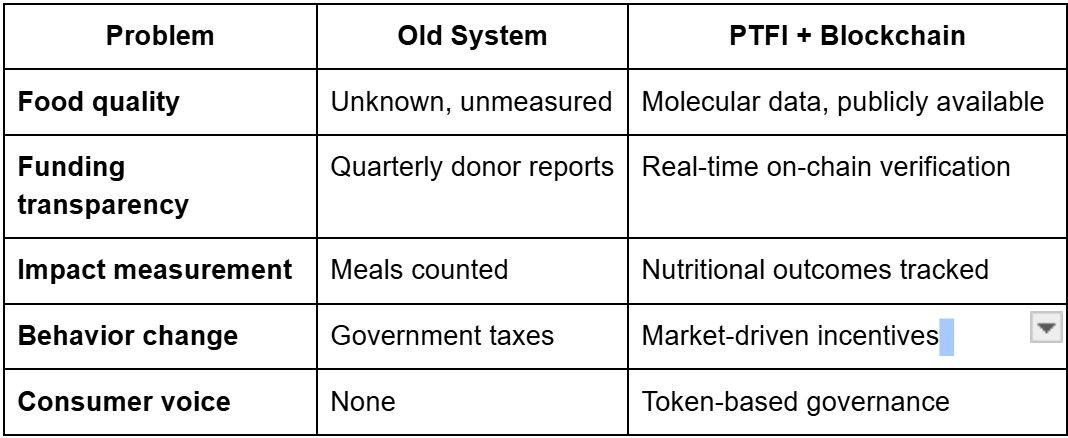
The infrastructure is converging. Rockefeller builds the food measurement layer. Blockchain builds the funding transparency layer. WHO pushes for economic behavior change.
Put them together and you get something unprecedented: a market-driven system where transparent funding flows toward measurable nutritional outcomes.
## The Counterargument (And Why I’m Still Bullish)
Look, I’ll be honest.
PTFI is still building their database. AI nutrition tools are early. $EAT launched six weeks ago. WHO tax proposals face massive industry opposition.
And the “peak calorie” thesis could be wrong. GLP-1 adoption might plateau. Immigration policy could reverse.
But here’s what I’m watching:
**The Rockefeller Foundation** is investing. The American Heart Association is building. **The World Economic Forum** is convening. Fortune 500 companies joined the **First Movers Coalition for Food**. WHO is launching new global initiatives.
When institutions this big align, infrastructure follows.
The food industry’s structural problems aren’t going away. The demand for transparent, outcome-based solutions isn’t going away. The technology to measure and verify isn’t going away.
The question isn’t whether food systems become more transparent and measurable. That’s already happening.
The question is who builds the systems that make it work.
## What You Should Do Next
If you care about this space, here are three moves:

1. Follow PTFI’s progress at [foodperiodictable.org](http://foodperiodictable.org). They’re building the measurement layer that makes verified impact possible.
2. Watch the WHO “3 by 35” initiative. If health taxes gain traction globally, economic mechanisms for food behavior change become mainstream.
3. Understand the blockchain angle. Whether it’s $EAT or other cause coins, this category is emerging. The transparency these systems provide solves problems traditional charity and traditional food policy can’t.
## The Real Question
Davos got one thing right: you can’t improve what you can’t measure.
But the food industry is facing a triple whammy of headwinds. Health authorities want to tax their way to better outcomes. Volume growth is ending.
The old model is breaking. Everyone knows it.
The world’s richest people are spending a week in Switzerland talking about food systems. They made real progress on the science.
Now we need to match that progress on the funding side.
Blockchain-verified charitable giving is happening right now. The only question is whether you’ll participate in building it, or watch from the sidelines.
What do you think? Is transparent, measurable food funding the future? Or am I connecting dots that don’t exist? Drop your take below.
———-
## Disclosure
This is an opinion based on Davos 2026, WHO, Kearney, and L.E.K. developments. Not financial advice. I co-founded WYDE and hold $EAT tokens. DYOR. Never invest more than you can afford to lose.
———-
## Sources & Further Reading
Davos / PTFI:
– [WEF: Unlocking the Future of Nutrition](https://www.weforum.org/stories/2026/01/future-nutrition-food-improve-lives/)
– [WEF: What is Metabolic Health?](https://www.weforum.org/stories/2026/01/obesity-epidemic-metabolic-health/)
– [WEF: Food Systems Innovation](https://www.weforum.org/stories/2026/01/food-systems-innovation-healthier-resilient-cities/)
– [Periodic Table of Food Initiative](https://foodperiodictable.org/)
Industry Analysis:
– [Kearney: Food Industry in New Operating Reality](https://www.foodbusinessnews.net/articles/29638-kearney-sees-food-industry-in-new-operating-reality)
– [L.E.K.: Food Sector Nears Peak Calories](https://www.foodbusinessnews.net/articles/29629-food-sector-nears-peak-calories-from-triple-whammy-headwinds)
– [Just Food: Why 2026 is a Reset Year for US Food Industry](https://www.just-food.com/comment/why-2026-is-a-reset-year-for-the-us-food-industry/)
– [Food Dive: Food and Beverage Trends 2026](https://www.fooddive.com/news/food-beverage-trends-2026/809061/)
– [Grocery Dive: 8 Grocery Industry Trends to Watch in 2026](https://www.grocerydive.com/news/8-top-trends-grocery-industry-2026/807564/)
WHO / Health Policy:
– [WHO: Higher Taxes on Sugary Drinks](https://www.who.int/news/item/13-01-2026-cheaper-drinks-will-see-a-rise-in-noncommunicable-diseases-and-injuries)
– [WHO: Global Report on Sugar-Sweetened Beverage Taxes 2025](https://www.foodbusinessnews.net/articles/29636-who-seeks-higher-taxes-on-sugary-soft-drinks)
– [UN News: Increase Taxes to Save Lives](https://news.un.org/en/story/2026/01/1166754)
– [Euronews: Countries Must Raise Taxes](https://www.euronews.com/health/2026/01/13/countries-must-raise-taxes-on-sugary-drinks-and-alcohol-to-curb-preventable-disease-who-sa)
GLP-1 & Food Industry:
– [FoodNavigator: The GLP-1 Effect: How 2026 Will Look](https://www.foodnavigator-usa.com/Article/2025/12/15/soup-to-nuts-podcast-how-will-glp-1s-reshape-food-in-2026/)
– [FoodNavigator: GLP-1 Ingredient Trends for Food Innovation](https://www.foodnavigator.com/Article/2026/01/15/glp-1-ingredient-trends-for-food-innovation/)
– [Food Ingredients First: New Year Menus Target GLP-1 Users](https://www.foodingredientsfirst.com/news/glp-1-friendly-menus-food-dining-2026.html)
– [FoodNavigator: Will GLP-1s Go Big in Europe in 2026?](https://www.foodnavigator.com/Article/2026/01/05/glp-1s-europe-success-in-2026/)
WYDE:
– [wyde.org](https://wyde.org/)
– @wydeorg everywhere
———-
Keywords: davos 2026 food, periodic table of food initiative, WHO sugar tax 2026, peak calorie food industry, kearney food report 2025, GLP-1 food industry, blockchain hunger relief, cause coins, $EAT token, food transparency blockchain, L.E.K. consulting food, 3 by 35 initiative WHO, food system transformation 2026, sugar-sweetened beverage tax, food industry reformulation, protein trend 2026