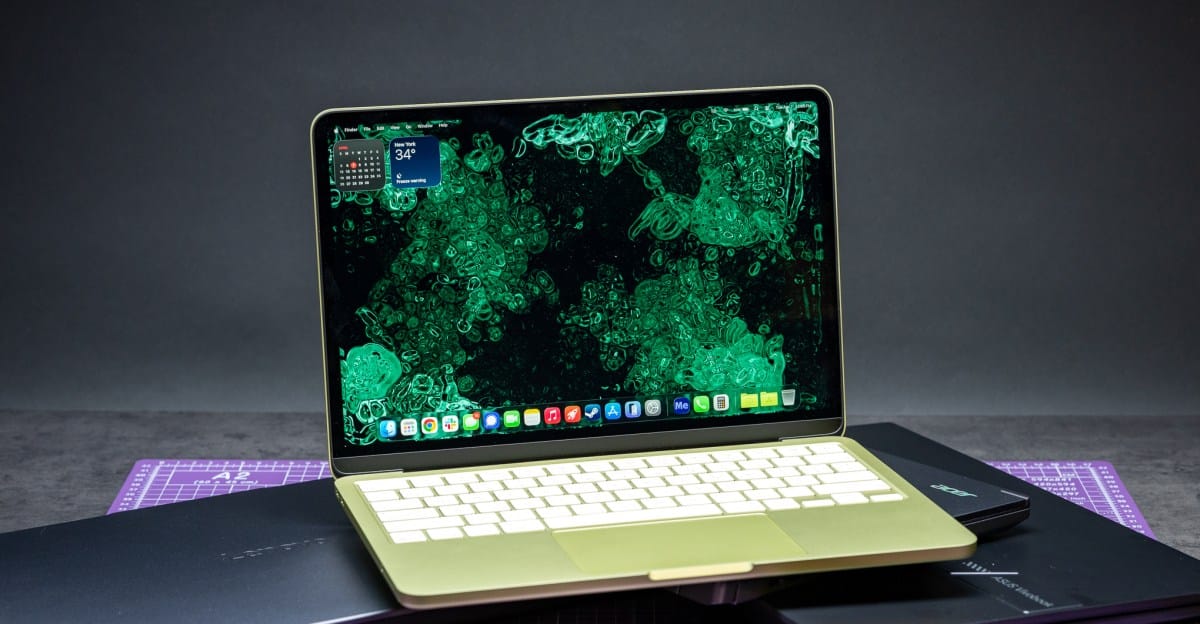
When the MacBook Neo arrived last month, I knew Windows laptop makers were in trouble. For $599, the Neo offers fantastic build quality and solid performance in a sleek and ultra-portable package. Windows laptops in this price range tend to be ugly, cheap-feeling, and a little slow.
Despite years of rumors, the MacBook Neo still seemed to take the Windows world by surprise. I expect proper competitors to pop up just as soon as the companies can manage, but I wanted to see what the competition in the PC space is like now.
So I asked a bunch of laptop manufacturers to send me their best answers to the MacBook Neo.

The MacBook Neo is a 13-inch, 2.7 pound all-aluminum laptop with an A18 Pro iPhone chip for its processor and just 8GB of RAM, starting at 256GB of (slow) storage. It costs $599 (or $499 for students and teachers), and for $100 more you get double the storage and a Touch ID fingerprint sensor in the power button. There aren’t any all-aluminum, 13-inch Windows laptops out there for $600. All of the Windows laptops I tested have MSRPs above $600 but are usually cheaper.
Asus sent a $700 Asus Vivobook 16 with an AMD Ryzen 7 processor (currently $530), Lenovo put up a $750 Lenovo IdeaPad Slim 3x with a Snapdragon X chip (currently $550), and Acer sent an Intel Lunar Lake Acer Aspire 14 AI, which is down from $1,050 to just $530. Dell and HP are between laptop generations and didn’t have any current models to send.
By Windows budget laptop standards, these are all good values. And on paper, they should be competitive. Each has an eight-core processor (versus six on the Neo), 16GB of RAM instead of 8GB, and between 256GB and 1TB of storage — the slowest of which is twice the speed of the Neo’s storage.


Let’s start with the least expensive. The Asus Vivobook is a large 16-inch laptop with a dull and plasticky build. Its chassis creaks and flexes nearly anywhere you touch it. The screen is large, but anything displayed on it looks drab, dim, and slightly blurry. 1920 x 1200 resolution is passable on a 14-inch screen, but not stretched across 16 inches.
The news isn’t better elsewhere. Its trackpad makes a loud hollow sound with every click, while its keyboard feels a little mushy. Its speakers are also audibly grating, making music and podcasts sound empty. And when on a call, the 720p webcam rendered a low-res, noisy image. It often struggled with backlighting from a window behind my head, with the image going from too dark to making me look like I was on the surface of the sun.
1/6
The Vivobook’s AMD Ryzen 7 7730U processor has eight cores, but the Neo’s are 75 percent faster. The Ryzen CPU is serviceable for light tasks like web browsing and basic apps, but even with 16GB of RAM it sometimes hangs longer opening apps thanks to its slower single-core performance. And the battery life isn’t anything special either. Trying to get through a regular workday of mixed usage (Chrome tabs, Google Docs, streaming music, and a short video call) yielded a maximum of six hours before it died. It does have a pretty good port selection, including three USB-A (one 2.0 and two 3.2), a headphone jack, HDMI 1.4, and one USB-C that can also be used for charging — which is good, because otherwise you’d have to bring the Vivobook’s barrel-plug charger with you.


$550
The Good
- Fantastic battery life
- Pretty good keyboard
- Decent port selection
The Bad
- Crappy, stiff trackpad
- Worst of the worst speakers
- Only one USB-C and a barrel plug charger
The $749.99 Lenovo IdeaPad Slim 3x has a slightly smaller, slightly better-looking screen than the Vivobook, and it’s the only touchscreen of the bunch. But at 300 nits the 15.3-inch display is equally dim and still middling quality. The keyboard here is better, with a touch of that tactile feel and deeper key travel that Lenovo is known for, but that’s about the only highlight of its build.
The trackpad feels stiff and sometimes difficult to click. And the speakers are the worst of this bunch. I like to listen to electronic music, like the Marathon and Armored Core soundtracks, to focus, but the speakers are so thin and treble-y that the repetitive beats, rather than letting me lock in, just gave me a headache.
1/6
The IdeaPad Slim uses a super efficient Arm-based Snapdragon X1-26-100 chip. While it’s the lowest-end of Qualcomm’s X1 processors, it performs fine for everyday tasks. An Arm chip means you can run into edge cases of app incompatibility, but it’s increasingly rare in the kinds of work most everyday users do on a computer.
The bright spot of the IdeaPad and its chip is battery life. It easily lasts a full workday and well beyond on a single charge. It’s the longest-lasting laptop of our battery rundown web-browsing test, running for over 21 hours. You can leave the charger at home for the day and not care, and that’s great because like the Asus it’s another barrel plug. Also like the Asus, it’s got a decent port selection, with a USB-C that also charges the laptop, two 5Gbps USB-A, HDMI 1.4, a 3.5mm audio jack, and even an SD card slot.


$530
The Good
- A great, well-rounded processor in a cheap laptop (if you get it on sale)
- Lots of ports, including Thunderbolt 4
- Very good battery life
- Can lightly game on ultra-low settings
The Bad
- Washed out screen with noticeable light bleed
- Bad speakers
- Poor build quality
The Acer Aspire 14 AI is the smallest and fastest of the Windows laptops I tested, and it has the most going for it — no doubt because it’s originally a $1,050 laptop. Thanks to its Intel Core Ultra 7 256V “Lunar Lake” processor, it’s faster than the other two Windows laptops. It’s still slower than the Neo on single-core tasks, but its multicore performance is better. When plugged in it can even handle a little gaming. I was able to play Marathon decently enough to be competitive. It was only workable on the lowest quality settings, but that’s better than nothing. And it has very good battery life. It doesn’t last as long as the Lenovo, but it lasts longer than the Neo — I saw almost 12 hours during light use.
The chip is most of what you’re paying for with the Acer, along with the port selection. While all three of these Windows laptops have a greater quantity and variety of ports than the MacBook Neo, only the Aspire 14 has Thunderbolt 4 and HDMI 2.1. Most of the rest of the laptop is just okay. We’re still in subpar speaker territory. The keyboard isn’t as good as the Lenovo’s, but it’s got enough key travel to feel fine. The trackpad is also passable compared to the Asus and Lenovo, but it still sounds plasticky when you click. And the laptop’s deck flexes as you push down on or around the trackpad.
1/5
But the Acer’s biggest weakness is its display. The 1920 x 1200 resolution on the 14-inch LCD panel is fine, but it looks washed-out, and there’s noticeable light bleed along some of the edges. It’s only visible when viewing dark backgrounds or scenes, but it’s unsightly.
Head-to-head component report cards
Laptop |
Screen |
Webcam |
Keyboard |
Trackpad |
Port selection |
Speakers |
Number of ugly stickers to remove |
|---|---|---|---|---|---|---|---|
| Apple MacBook Neo | B | B | C | A | D | B | 0 |
| Acer Aspire 14 AI | D | C | C | C | A | D | 3 |
| Asus Vivobook 16 | D | F | D | D | C | D | 4 |
| Lenovo IdeaPad Slim 3x | C | D | B | D | C | F | 3 |
The flaws shown by all three of these Windows laptops — lackluster screens, crummy-sounding speakers, and middling trackpads — are almost impossible to avoid on laptops in this price range. But the game has changed: The MacBook Neo exists. And it smokes all of them in quality-of-life territory. It’s got a brighter, more colorful screen; a trackpad you can easily click anywhere; a sharp webcam that does your face some justice; and speakers that don’t assault your ears. It even has a hinge you can open smoothly with one finger — the Windows laptops snap closed or slide around if you try to do the same.
1/3
This trio of Windows laptops each has 16GB of RAM to the Neo’s 8GB, but it barely makes a difference in actual use. They too can slow down a bit if you open tons of Chrome tabs on them just like the Neo. The Neo even beat the Lenovo and Asus in our Premiere 4K export test, even though it’s short on RAM and completely fanless. Impressive.
Benchmark tests comparison
System |
CPU cores |
GPU |
Geekbench 6 CPU Single |
Geekbench 6 CPU Multi |
Geekbench 6 GPU (OpenCL) |
Sustained SSD reads (MB/s) |
Sustained SSD writes (MB/s) |
Premiere 4K Export (lower is better) |
Street price as tested |
MSRP |
|---|---|---|---|---|---|---|---|---|---|---|
| MacBook Neo / Apple A18 Pro / 8GB / 256GB | 6 | A18 Pro (5 GPU cores) | 3402 | 8508 | 19798 | 1735.91 | 1684.05 | 8 minutes, 30 seconds | $599 | $599 |
| Acer Aspire 14 AI / Intel Core Ultra 7 256V / 16GB / 1TB | 8 | Intel Arc 140V(8 GPU cores) | 2769 | 10930 | 28556 | 6391.51 | 5524.22 | 7 minutes, 28 seconds | $529.99 | $1,049.99 |
| Lenovo IdeaPad Slim 3x / Qualcomm Snapdragon X X1-26-100 / 16GB / 256GB | 8 | Adreno X1-26 | 2137 | 9728 | 9689 | 5738.86 | 2801.02 | 12 minutes, 59 seconds | $549.99 | $749.99 |
| Asus Vivobook 16 / AMD Ryzen 7 7730U / 16GB / 1TB | 8 | AMD Radeon (8 GPU cores) | 1925 | 6916 | 15594 | 3721.87 | 3254.11 | 15 minutes, 29 seconds | $529.99 | $699.99 |
The MacBook Neo is the easy choice among these four laptops. It has its own struggles; you can totally bog it down with lots of Chrome tabs or by multitasking while running a heftier content creation app like Lightroom. But its single-core performance is better than any Windows laptop here, making it more than fast enough for most users. It’s also colorful and fun, and its hardware is all-around great compared to other laptops in this price range (with the small exception that its keyboard is annoyingly not backlit). If I had to pick a Windows model among this selection, I’d go with the Acer Aspire 14 AI. I’d also connect a mouse and keyboard, plug it into a monitor and speakers, and try to use it that way as often as I could (but that takes it out of “budget” territory if you don’t own all those peripherals already). It’s well rounded in terms of performance and ports, but not in hardware quality.
For some folks, it’s also worth considering a nice Chromebook like the Lenovo Chromebook Plus 14. It’s not as nice as the MacBook Neo, but it’s close — it’s got a lovely OLED screen, excellently tactile keyboard, good speakers, and fantastic battery life. ChromeOS is fine if you just need to live in a browser, or if you’re comfortable enabling its Linux virtual machine to get access to more apps. But you don’t get as fully featured of an operating system out of the box as you do with macOS or Windows. It’s my favorite Chromebook, but these days I’d still just take the Neo and save money in the process. (It’s still wild to think of a Mac as the cheaper alternative to a Chromebook.)
1/7
There’s just no competing with the Neo at this price, at least at this time. There’s Microsoft’s Surface Laptop 13-inch, which is very close in quality to the Neo’s build, but it still can’t touch that A18 Pro chip’s single-core performance. It starts at $900, though you can often find it for less. Climb into the $1,200-plus range (to the world of Asus Zenbooks, Lenovo Yoga Slims, the 13.8-inch Surface Laptop, etc.) and things get much nicer with better builds, OLED screens, and higher-end chips. But then you’re also competing with the MacBook Airs.
I’ve heard murmurs that some PC laptop makers are aiming to release proper Neo competitors this year, but it’s going to be difficult for any PC company to compete on price and hardware quality. Apple manages it with the Neo thanks to its vertical integration, complete with its own operating system and in-house chip. PC makers have to figure out a way to stop cutting the wrong corners, like screens, trackpads, and speakers. And they need to do that without raising prices. That’s going to be hard, especially now. But if they can’t, the Neo will be the easy answer again and again.

Specs as tested, compared
Laptop |
MacBook Neo |
Acer Aspire 14 AI |
Asus Vivobook 16 |
Lenovo IdeaPad Slim 3x |
|---|---|---|---|---|
| Display | 13-inch (2408 x 1506) 60Hz IPS LED | 14-inch (1920 x 1200) 60Hz IPS LED | 16-inch (1920 x 1200) 60Hz IPS LED | 15.3-inch (1920 x 1200) 60Hz IPS touchscreen LED |
| Display brightness | 500 nits | 300 nits | 300 nits | 300 nits |
| Display color gamut (measured) | sRGB: 98%AdobeRGB: 72%DCI-P3: 73% | sRGB: 66%AdobeRGB: 49%DCI-P3: 49% | sRGB: 69%AdobeRGB: 52%DCI-P3: 51% | sRGB: 68%AdobeRGB: 53%DCI-P3: 53% |
| Processor | Apple A18 Pro | Intel Core Ultra 7 256V | AMD Ryzen 7 7730U | Qualcomm Snapdragon X X1-26-100 |
| RAM | 8GB | 16GB | 16GB | 16GB |
| Storage | 256GB SSD | 1TB | 1TB | 256GB |
| Webcam | 1080p FaceTime HD camera | 1080p with IR | 720p with privacy shutter | 720p with privacy shutter |
| Biometrics | None (Touch ID fingerprint sensor optional on 512GB configuration) | Windows Hello face unlock | Fingerprint sensor built into trackpad | Fingerprint sensor built into chassis |
| Connectivity | Wi-Fi 6E, Bluetooth 6 | Wi-Fi 6, Bluetooth 5.3 | Wi-Fi 6E, Bluetooth 5.3 | Wi-Fi 7, Bluetooth 5.4 |
| Ports | 1x USB 3 (Type C) up to 10Gbps with DisplayPort, 1x USB 2.0 (Type C) up to 480Mbps, 3.5mm combo audio jack | 2x Thunderbolt 4 / USB4 (Type C), 2x USB 3.2 Gen 1 (Type A), HDMI 2.1, 3.5mm combo audio jack | 1x barrel-plug charging port, 1x USB 3.2 Gen 1 (Type C), 2x USB 3.2 Gen 1 (Type A), 1x USB 2 (Type A), HDMI 1.4, 3.5mm combo audio jack | 1x barrel-plug charging port, 1x USB 3.2 Gen 1 (Type C), 2x USB 3.2 Gen 1 (Type A), HDMI 1.4, SD card slot, 3.5mm combo audio jack |
| Keyboard backlight | No | Yes | Yes | Yes |
| Weight | 2.7 pounds / 1.23kg | 3.09 pounds / 1.4kg | 4.14 pounds / 1.88kg | 3.42 pounds / 1.55kg |
| Dimensions | 11.71 x 8.12 x 0.5 inches / 297.5 x 206.4 x 12.7mm | 12.6 x 8.9 x 0.67 inches / 320 x 226.1 x 17mm | 14.12 x 9.82 x 0.78 inches / 358.7 x 249.5 x 19.9mm | 13.52 x 9.51 x 0.7 inches / 343.4 x 241.6 x 17.8mm |
| Battery | 36.5Whr | 65Whr | 42Whr | 65Whr |
| MSRP | $599 | $1,049.99 | $699.99 | $749.99 |
| Street price | $599 | $529.99 | $529.99 | $549.99 |
Photography by Antonio G. Di Benedetto / The Verge