A stay at Hyatt’s newest Andaz raises a question every luxury traveler should ask before booking
When AAA’s inspectors visited Andaz Miami Beach in 2025 and applied their 27-criteria framework, they arrived at a verdict: Four Diamond. Not Five.
That’s a meaningful credential. Four Diamond denotes “upscale, refined” properties with personalized service and high-end furnishings, and thousands of hotels in North America don’t earn it. But Five Diamond, AAA’s top designation, is reserved for the small group of properties operating at the absolute pinnacle of the luxury tier. Roughly 115 hotels hold it across all of North America. Andaz Miami Beach is not among them. The property is also not listed on Forbes Travel Guide’s 2026 Five-Star list for Miami, which recognized five properties: Acqualina Resort, Faena Hotel Miami Beach, Four Seasons Hotel at The Surf Club, The Setai Miami Beach, and The St. Regis Bal Harbour Resort.
This is, in other words, exactly the kind of clarifying data the independent inspection regimes exist to produce.
A reporter’s stay at Andaz Miami Beach in May 2026, one year after the property’s grand opening, produced an operational picture that broadly aligned with what the AAA designation already suggested. It also raised a separate question, and not one specific to Hyatt. It is a question every traveler booking at “luxury” rate cards should be asking before they commit the night’s rate: what, exactly, are you paying for?
The Property, As Marketed
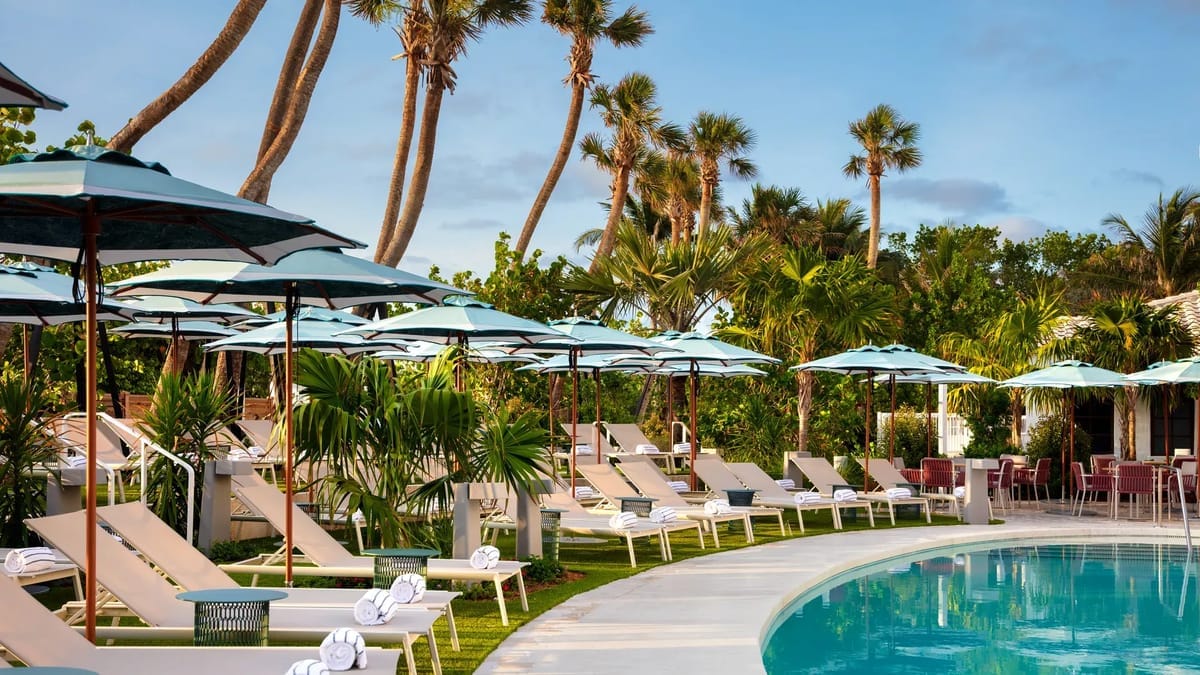
Andaz Miami Beach opened on May 5, 2025 with all the language of arrival. The first Andaz in Florida. A roughly $60M renovation of the former Confidante Miami Beach, owned by Sunstone Hotel Investors. Three planned dining concepts by the José Andrés Group. Two heated outdoor pools. A members’ beach club. A “first-of-its-kind ocean-view check-in experience.” Standard room rates run between roughly $500 and $800+ per night depending on season, with suites priced well above that.
The opening was also Hyatt’s first new property under its newly formed Lifestyle Group, a division consolidated after Hyatt’s 2024 acquisition of Standard International and led by former Standard executive chairman Amar Lalvani.
Hyatt’s brand language is consistent across public materials. Andaz is positioned as “luxury lifestyle.” The corporation, in 2024 strategic communications, framed itself as having “doubled the number of luxury rooms, tripled the number of resort rooms, and quintupled the number of lifestyle rooms” globally since 2017.
Worth noting: Hyatt itself does not formally describe Andaz Miami Beach as “five-star” in its public materials. “Five-star” is what consumers, third-party hotel directories, and rate-card-driven shorthand apply to properties operating at this price tier. That distinction, between what an operator formally claims and what consumers infer, is part of the question this piece is built around.
This is the brand promise. Whether it is being kept is a separate matter.
What We Found
Over a multi-night business stay in May 2026, this reporter observed and documented a pattern of operational issues that, considered individually, would be unremarkable at a midscale property. Considered together, at the price point Andaz Miami Beach commands, they raise the question this piece is built around.
The list, in order of severity:
Pool sanitation. A bodily fluid contamination event, appearing to be either vomit or fecal matter, was visible in the property’s adult pool during one day of the stay and remained unaddressed for the entirety of the poolside period that day. The CDC’s Model Aquatic Health Code, which serves as the industry baseline for U.S. public pools, requires immediate pool closure and a documented disinfection protocol for any visible contamination event. The contamination at Andaz Miami Beach remained visible without any apparent staff response for hours.
Adult pool policy enforcement. The property markets a designated adult pool. Children were present in the adult pool throughout the stay, with no visible enforcement of the age policy.
Pool capacity. Lounger availability was exceeded by demand on multiple days. Guests waited several hours for a chair to open.
Room product and construction. Walls between guestrooms transmitted neighbor noise (conversation, television, movement) at a level unusual at a four-star property and unexpected at this rate. The gap at the bottom of the guestroom door was sufficiently large that hallway noise was continuously audible inside the room; guests rolled a towel against the door at night as a workaround. The in-room aesthetic (furniture, fixtures, surface materials) read as dated and would be appropriate for an upper-midscale property, not matching either the renovation narrative or the rate card. Bathroom lighting on motion-sensor timers cut out mid-shower on four to five separate occasions, leaving the guest in darkness. A configuration error any building engineer should be able to identify and correct in an afternoon.

Service consistency at the pool and beach. Drink orders placed multiple times were inconsistent in preparation; the same drink ordered the same way was returned to the bar as incorrect on several occasions. Wait times for initial service, including obtaining a menu, were long enough that guests stood up and approached the bar directly.
Housekeeping consistency. The standard of daily housekeeping varied materially across the stay. Some services were executed well; others were notably incomplete. The variation suggests a gap in service-standard supervision or training across the housekeeping team.
Billing transparency. The property charged the guest’s incidentals authorization mid-stay rather than at checkout, which the front desk described as a security policy. This is not unique to Andaz, but it is unusual at this tier and was not disclosed at check-in.
In-room communications. In-room phones rang without answer on multiple occasions; on others, the line returned a busy signal.
Any one of these items, isolated, is the kind of thing a guest waves off. The aggregate, particularly the pool sanitation issue (which crosses from hospitality into health-and-safety territory) is the gap this piece is reporting on.
The Portfolio Sleight of Hand
Here is where the industry framing becomes useful, and where readers booking “luxury” at any brand should pay attention.
Hyatt, like every major hotel operator, runs a tiered brand portfolio. In its 2024 brand architecture, the company formally organizes its properties into five portfolios: Luxury, Lifestyle, Inclusive, Classics, and Essentials.
The Luxury portfolio is anchored by Park Hyatt and includes Alila, Miraval, Impression by Secrets, and The Unbound Collection by Hyatt. The Lifestyle portfolio (distinct from Luxury in Hyatt’s own framing) is anchored by Andaz, Thompson Hotels, The Standard, Dream Hotels, and JdV by Hyatt.
This distinction matters. “Luxury lifestyle” is a marketing category, not a tier rating. It is shorthand the industry uses for design-forward, experience-oriented properties priced near the top of the market. It is not, in Hyatt’s own internal architecture, the same designation as Hyatt’s luxury flagship. A guest assuming an Andaz property operates at Park Hyatt service standards is making an assumption Hyatt has not actually made. The rate card sometimes overlaps. The brand positioning sometimes overlaps. The operational standards (staff training, inspection rigor, corporate accountability) may not.
This is not a criticism of the architecture. It is an observation about how easily the architecture gets blurred in customer-facing marketing.
What Independent Inspectors Saw
Outside the hotel companies themselves, two organizations maintain independent rating regimes that travelers can verify rather than infer.
Forbes Travel Guide uses anonymous inspectors who evaluate properties against more than 900 service and facility standards, with a heavy weighting toward service execution. A property must meet roughly 90% of those standards to earn a Five-Star rating. Approximately 54 hotels in North America currently hold it.
AAA’s Diamond rating uses on-site evaluators and a 27-criteria framework that weights physical product alongside service. Roughly 115 hotels in North America hold the AAA Five Diamond designation; thousands more hold Four Diamond.
The properties that hold both designations (Forbes Five-Star and AAA Five Diamond) represent the actual top of the North American luxury hotel market by independent verification. In Miami specifically, those properties include Acqualina Resort, Faena Hotel Miami Beach, Four Seasons Hotel at The Surf Club, The Setai Miami Beach, and The St. Regis Bal Harbour Resort, all five of which earned 2026 Forbes Five-Star designation per Forbes Travel Guide’s February 2026 announcement.
Andaz Miami Beach does not appear on that list.
AAA, separately, awarded Andaz Miami Beach a Four Diamond designation in August 2025. By AAA’s own definition, Four Diamond denotes “upscale, refined” properties with personalized service and high-end furnishings. Five Diamond is reserved for the small group of properties operating at the absolute pinnacle of the luxury tier.
The data tells you what you need to know. When AAA’s evaluators visited Andaz Miami Beach and applied their criteria framework, they arrived at Four Diamond, not Five. That is a useful data point for any guest weighing the rate card against the brand language. It is also broadly consistent with the operational picture this reporter observed during a stay one year into the property’s life.

When a property is described as “five-star” in consumer language, it is worth asking who is doing the describing. In the absence of a Forbes Five-Star or AAA Five Diamond designation, “five-star” is, almost always, the rate card and the marketing.
Three Questions to Ask Before You Book “Luxury” in 2026
For readers (many of whom book luxury accommodations regularly for business and personal travel, and expect the rate to correspond to the experience) the question raised by this piece is structural.
When you book “luxury,” what are you actually buying?
Are you buying the rate card? Are you buying the brand’s tier within its parent company’s own portfolio? Are you buying an independent inspection regime that has verified the property meets defined service and facility standards? Or are you buying the marketing language, which is the cheapest of the four to produce and the most flexible in what it can be made to mean?
The hotel industry has, for the last decade, increasingly relied on the third category (proprietary brand language like “luxury lifestyle,” “ultra-luxury,” “experiential luxury”) in ways that obscure the absence of independent verification. The trade-off works for the operators. It is less clear that it works for the guest.
The next time you book at a property where the rate card has reached genuine luxury pricing, three questions are worth asking:
1. Is this property in the operator’s “Luxury” portfolio, or in an adjacent category like “Lifestyle” or “Premium”? The terms are not interchangeable. The portfolios are defined by the operators themselves and are publicly disclosed.
2. Does this property hold a Forbes Five-Star or AAA Five Diamond rating? Both organizations publish their lists. Properties that hold both are operating at a verified pinnacle. Properties that hold one are operating at a verified luxury or near-luxury tier. Properties that hold neither (including many marketing themselves as “five-star”) have not been independently certified at that level.
3. What do recent first-person accounts say about the day-to-day experience? The gap between marketing and execution is widest at properties where the brand has expanded rapidly into new markets and operational rigor has not yet caught up.
These three questions take five minutes. In many cases, they will save more than the cost of the stay in disappointment alone.
The Bigger Picture
The Andaz brand is not the problem. Hyatt is not the problem. The José Andrés culinary partnership (which has launched Aguasal and Bar Centro on property, with The Bazaar by José Andrés announced to follow) is not the problem. The renovation of The Confidante into Andaz Miami Beach was, by all visible accounts, a substantial investment in a high-potential property, and the brand position the company has chosen for it is internally coherent.
The problem is the gap between what the brand promises a guest at this rate and what the property delivered on the days this reporter was on site. That gap is reparable. Hotel operations are reparable. Pool sanitation policy enforcement is reparable. Service training is reparable. Door seals and acoustic gaps are reparable. The path from Four Diamond to Five Diamond is well documented, and Hyatt knows it as well as any operator in the world.
What is harder to repair (and what this piece is ultimately about) is the diluted meaning of “five-star” in 2026. That repair will not come from any single property. It will come from travelers asking sharper questions before they book, and from the industry tightening the language it uses when it answers.
Reporting based on a first-person business stay at Andaz Miami Beach in May 2026. The reporter paid for the stay in full at the published rate; no comp, discount, or commercial relationship existed between The Tech Buzz and Hyatt Hotels Corporation at the time of the stay or this writing.
Hyatt corporate communications was contacted prior to publication with a request for response, with a deadline of Friday, May 15, 2026. This piece will be updated to reflect any response received.